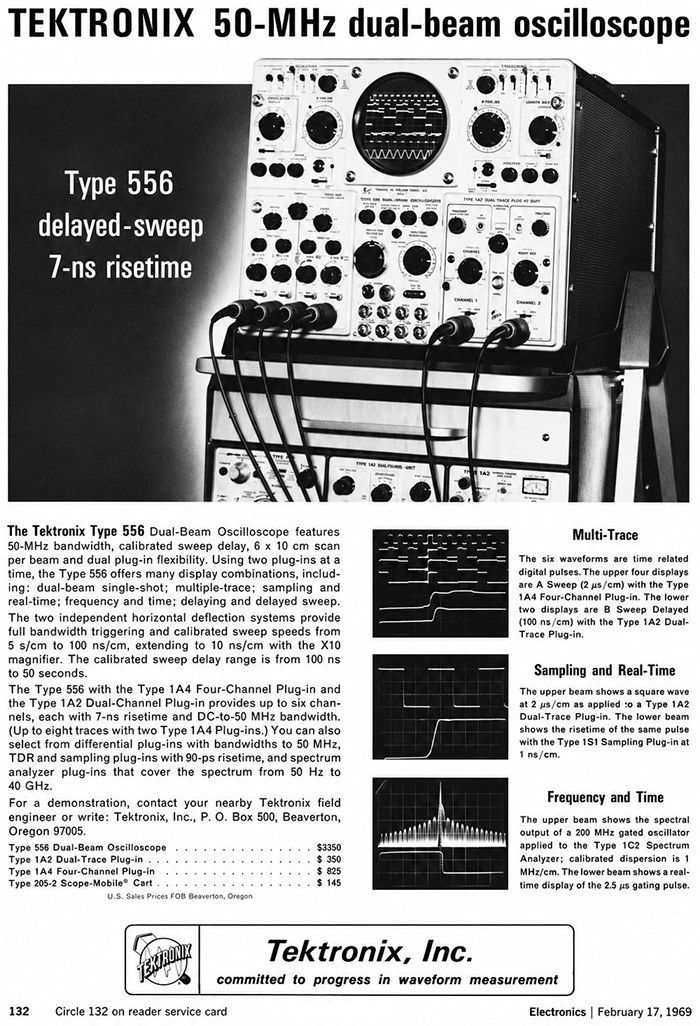
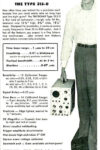
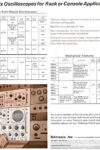
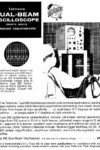
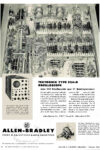
The September 2026 Ad of the Month highlights the dual-beam, 50 MHz Type 556 oscilloscope from the February 17, 1969 issue of Electronics. The ability to display more than one trace at a time is a highly-coveted trait and the 556 took this to an extreme for an analog oscilloscope. It was effectively two separate oscilloscopes sharing a common CRT. And the 50MHz bandwidth was only exceeded at the time by the 85MHz Tek 585A.

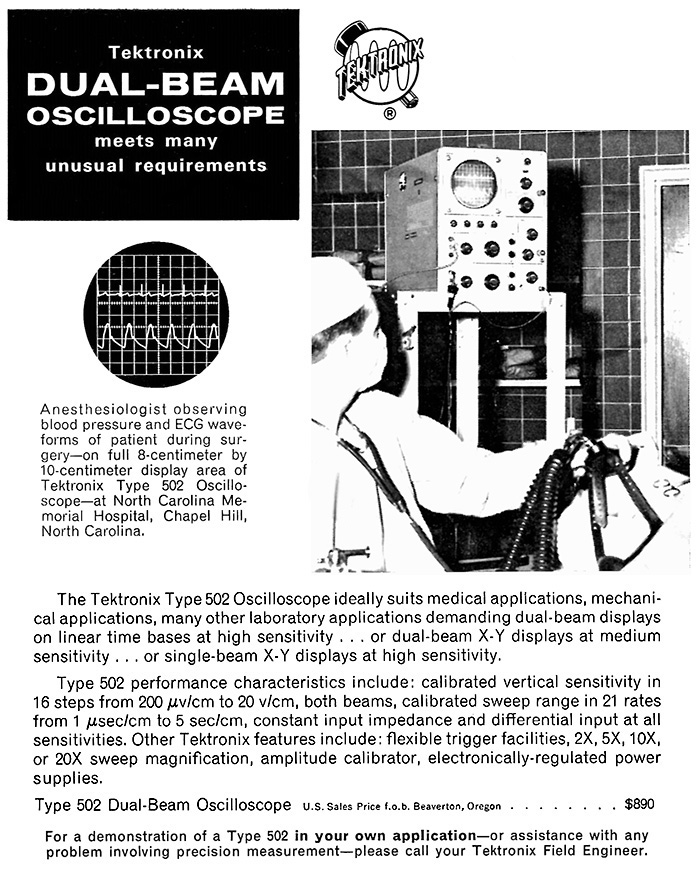
The CRT incorporated two electron guns from the popular 50 MHz 547 oscilloscope that were retooled to accommodate the dual-gun configuration. Both the 547 and the 556 guns were designed by Connie Wilson. The two guns required extensive shielding to prevent crosstalk between the two beams. By having a pair of separate electron guns the 556 could display signals from two completely different sources. Tektronix didn't make the distinction between "Dual-Beam" and "Dual-Gun." Other "Dual-beam" Oscilloscopes, e.g. the 502, 551 and 5030, had separate triodes, focus and vertical deflection in their electron guns, but they shared horizontal deflection capability, requiring signals under test have the same time base.

So-called "dual trace" oscilloscopes multiplexed a single beam to create two traces, as used in the 581 and 585. Other Tek Dual-Gun scopes were the 555 (30MHz), 565 (10MHz), 5444 (60MHz) and the 7844 (400MHz!).

As the ad points out, use of a Type 1A4 Four-Channel Plug-in and the Type 1A2 Dual-Channel Plug-in provided up to six usable channels (up to eight channels could be created with two 1A4 Plug-Ins). Realistically however, even six separate waveforms might be hard to resolve on a five-inch round CRT screen. The premium TDS oscilloscopes in the 1990s used full color from Tek's Liquid Crystal Color Shutter displays to help discriminate four traces simultaneously. The modern Tektronix 5-Series MSO is an 8-channel oscilloscope, with a large active-matrix LCD.

Design responsibilities for the 556 were delegated to Phil Crosby after he completed the RM529, as he describes in our September Photo of the Month article. Phil describes his work on the 556 in his Employee Story - The 556 Story. The task was apparently more difficult than initially thought.

The 556 was introduced in the 1966 Tektronix Catalog for $3,150 (roughly $32,600 today) and a rack-mount version was available for $3,250. At the time of the ad the 556 price had been increased to $3,350.

Bob Oblack, who started at Tektronix as a test technician and retired as the Marketing Manager for Portable Scopes, recalled that Tektronix Sales Engineers pitched the 556's high bandwidth and multi-trace capability as a deluxe upsell to customers considering less expensive instruments. The successor to the 556 was the dual-gun, 400 MHz 7844, although as Phil recalls in his writeup, the 556's life was extended because it initially had a better spot than the 7844. When production ceased in 1975, the 556 was the last of the highly successful 500-series line.


Advertisements of the Month: Sept 2025 - Present.