Murdock Charitable Trust Display Case by vintageTEK
The M. J. Murdock Trust was established from the estate of Jack Murdock. The Trust helps support community-focused organizations at every level of their development through grants, programming, and other resources. Recently the Trust reached out to the museum to assemble a display case that commemorates Jack Murdock and his contributions. Archivist Pat Green took on the project and created storyboards to accompany various items donated by the museum to highlight his life's contributions.
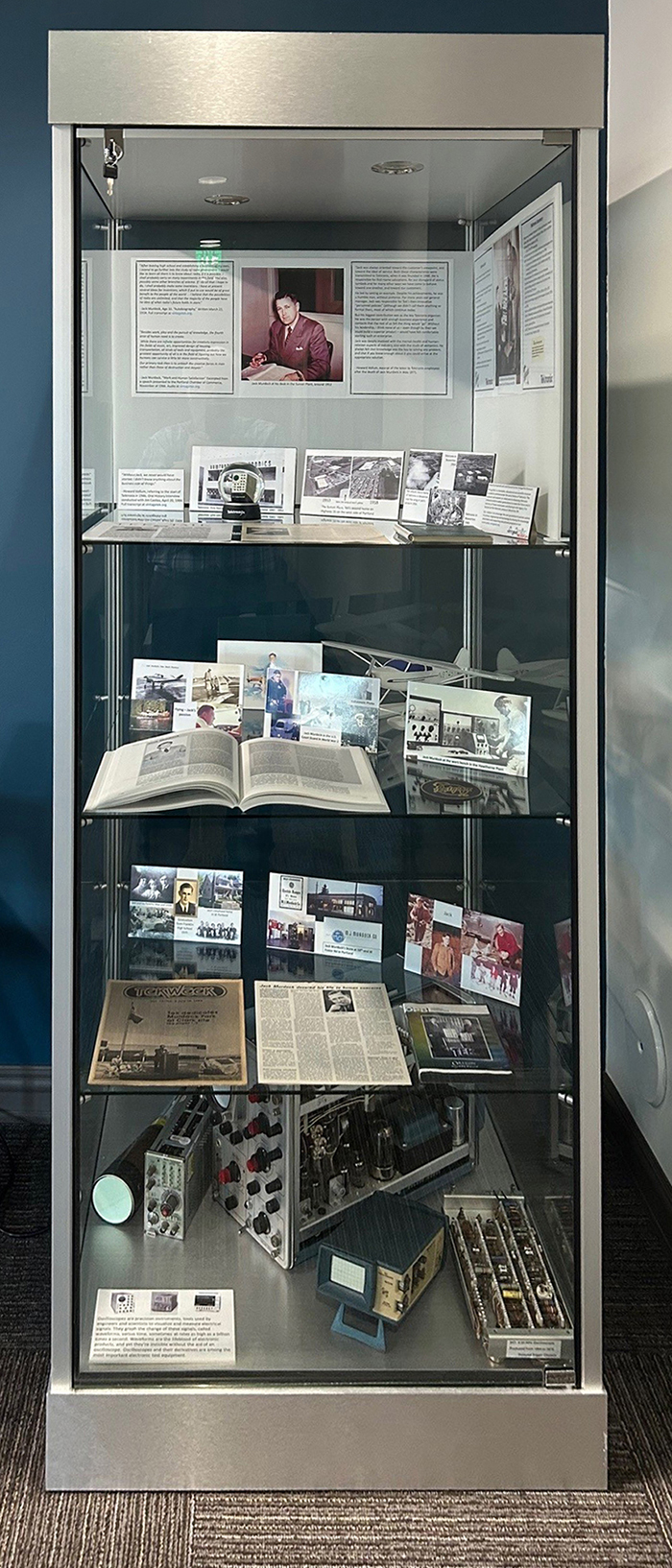
The storyboards in the display case can be viewed as PDFs in the links below.
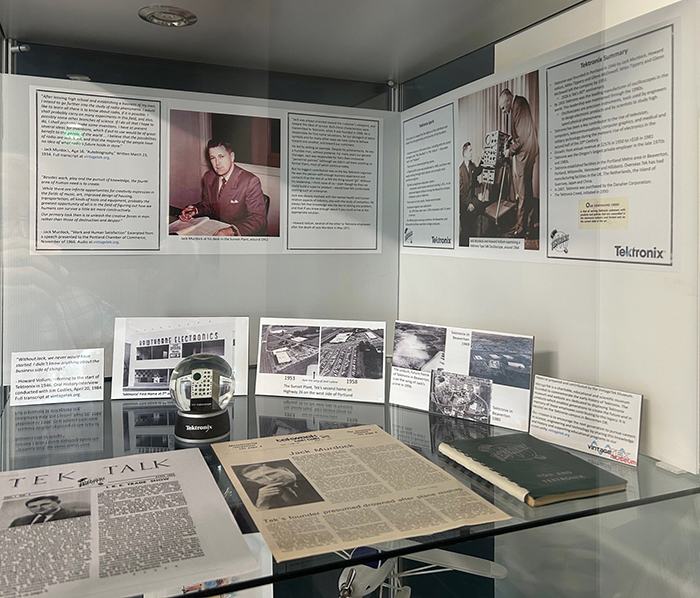
The top shelf highlights Jack's career at Tektronix starting with Hawthorne Electronics and growth to the Sunset and Beaverton plants. It has a short biography of Jack Murdock that appeared in Tek Talk in April, 1952, a tribute to Jack Murdock after his passing from Tekweek in 1971, an employee manual form the early 1950s and a snow globe containing a Type 511 oscilloscope model, Tektronix first oscilloscope product.
The storyboards across the back contain an excerpt of Howard Vollum’s letter to Tektronix employees after Jack’s death when his float plane crashed on the Columbia River in May of 1971, a unique color photo of Jack in the Sunset Plant taken by Tek engineer Logan Belleville around 1952, and an excerpt from an autobiography written by Jack at age 16. Remarkably, he accurately predicted how he would start his own retail appliance business, shown in another storyboard below. Jack sold a broad line of radios at the store on SE Foster Road. He later expanded his business to include radio service, and hired Howard Vollum to do the repairs. This started a 35-year friendship and business relationship between the two of them. Note that if you replace the word “radio” with “electronics” in his essay, his comments are even more prescient.
An excerpt from a speech Jack gave to the Portland Chamber of Commerce in 1966 is found below the quote from his autobiography. This reflects one of his career-long interests: seeking how to improve human interactions, especially in the workplace. The recording of the entire speech can be found on our Audio Gallery.
The storyboard on the right summarizes the Tektronix Spirit, a unique by-product of Jack and Howard’s management style creating a productive and employee-friendly workplace that made Tek an especially desirable place to work, a photo of Jack and Howard with a 50 MHz Type 546 oscilloscope, introduced in 1964, mounted on a Type 204 Tek-Mobile cart. This is an instrument from the Classic Period of Tektronix oscilloscopes when the company established dominance in the oscilloscope market, incorporating the plug-ins that Tektronix pioneered.
The last page in the storyboard is a summary of Tektronix, including the “Creed” statement that appeared in Tektronix catalogs starting the 1951. Both the original logo, the Tek “Bug,” and the current logo are featured at the bottom.
Across the shelf are five smaller storyboards, the center three include a photo of Tek’s original home on SE Hawthorne, as well as aerial site photos of Sunset and Beaverton facilities. There are also small storyboards: one quoting Howard Vollum on how Tek wouldn’t have been founded without Jack Murdock; the other has a description of the vintageTEK Museum.
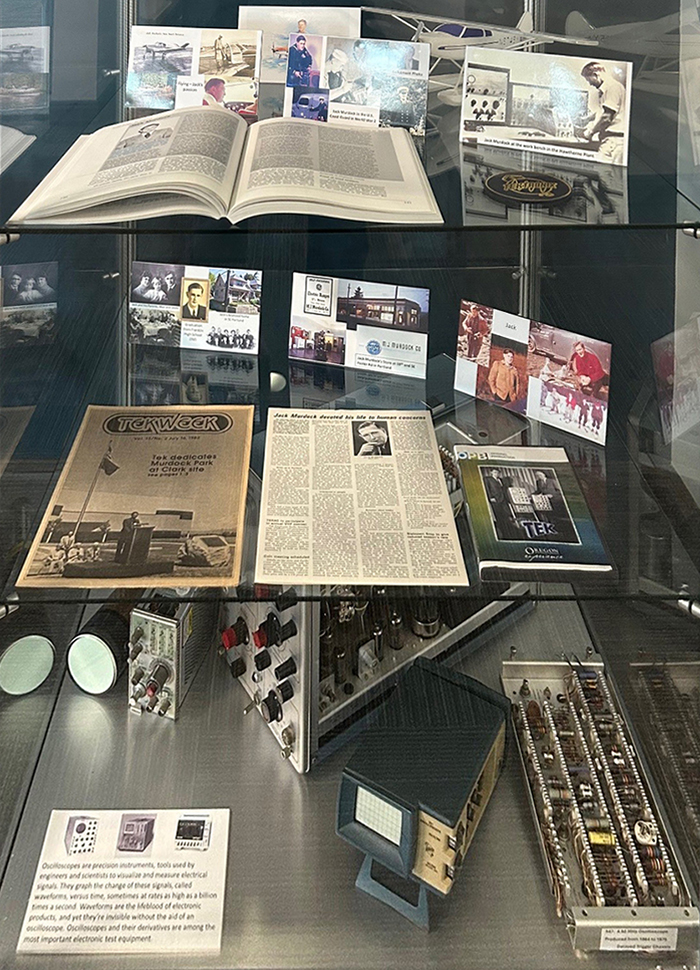
The second shelf contains a model of one of Jack planes, Marshall Lee’s 1986 history of Tektronix open to a section about Jack, and a coaster with the “Tek bug.” The storyboards depict Jack’s love of flying, a watercolor portrait with his float plane in the background, his time in the US Coast Guard during World War II, and rare photo of him at a workbench at the Hawthorne plant.
The third shelf contains a Tekweek from 1981 covering the opening of Jack Murdock Park in Vancouver, Washington, where where portable oscilloscopes were manufactured in the 1980s. Another Tekweek published after Jack’s death is displayed, as well as a DVD case for the Oregon Public Broadcasting program about Tektronix. The storyboards highlight collection of photos of his family, his home in SE Portland and his 1935 graduation photo from Franklin High School in Portland, his store on Foster Road, as well as an Oregonian ad, and his business card, identifying his business as “The House that Jack Built” and other personal photos.
The bottom shelf contains a 3-inch diameter Tektronix-made CRT (cathode ray tube), a 7000-series oscilloscope plug-in, a Type 317 Tektronix oscilloscope, a Type 211 Tektronix mini-scope and a module from an early Tek scope incorporating Tektronix-proprietary ceramic strips for mounting passive electronic components in an orderly fashion in the days before printed circuit boards. The storyboard describes oscilloscopes and their importance in electronics test and measurement.