
The Tektronix 422 in Vietnam: The “Shush” Missions
Australian Army airborne direction finding grew out of the Pacific campaigns of WW2 and the Malayan Emergency (1956-63). Finding enemy forces under thick jungle was difficult, and locating their radio transmitters without flying over them and alerting them became essential.
Australia’s presence in Vietnam began in 1962 with advisors, followed by an infantry battalion in 1965. The Army raised a dedicated aviation unit, No. 161 Reconnaissance Flight, which flew Airborne Radio Direction Finding (ARDF) missions daily until it left in December 1971. They provided extremely useful intelligence on enemy movements.
How The System Worked By 1965 the Weapons Research Establishment (WRE) had built a prototype ARDF unit small enough for the Army’s Cessna 180. Field tests in Vietnam in early 1967 showed it was both successful and highly accurate.
The system was a hand-built rack holding:
2 x RACAL 217 receivers
1 x Tektronix 422 oscilloscope
A custom power supply running from the aircraft’s 24V DC system
A Rustrak chart recorder
An Akai reel-to-reel tape recorder
The rack sat on a base that also carried a semi-retractable circular antenna, mounted on a mast reaching into the airflow. The operator turned the antenna by hand with a wheel at the base of the mast. Together, the equipment let the crew intercept, record and “fingerprint” enemy radio transmissions. The operator passed bearings to a ground station, which plotted them and triangulated the transmitter’s position.
Inside The Aircraft The unit was so bulky that the co-pilot’s seat and control yoke had to be removed to fit it. The operator, a signals specialist from 547 Signals Troop, sat on the rear bench seat facing forward, with the antenna hand-wheel between his feet. A portable PRC-77 radio and a KY-38 encoder gave him secure voice contact with base.
Why “Shush”? Signals Intelligence (SIGINT) missions were highly classified. When anyone asked about the unusual equipment in the Cessnas, the answer was a finger to the lips and a “Shhhhh”. The sorties soon became known as “Shush” missions.
What Survives Today It is believed that WRE in Adelaide built only a prototype and five pre-production systems. After returning to Australia they served as training aids, but had largely disappeared by the late 1970s. Only one semi-complete example remains, at the Australian Army Signals Museum in Victoria.
Darryl Hill owns and flies one of the three surviving Army C-180s used in Vietnam (A98-063). He has restored it to its 161 Recce Flight configuration, battle-damage repair patches included, and flies it as a memorial to Vietnam veterans.
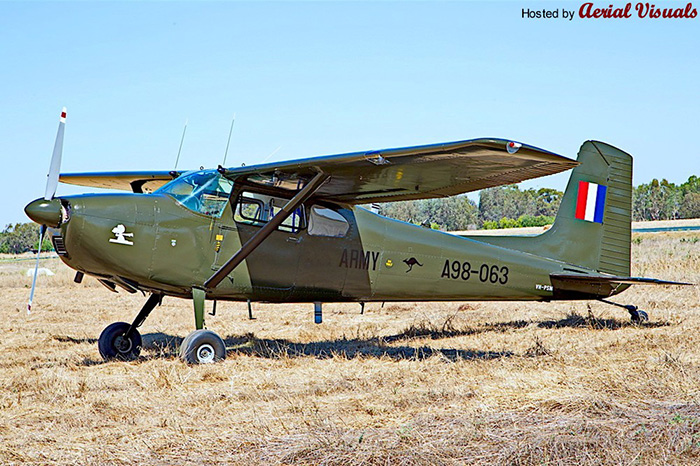
Photo courtesy of Arthur Scarf
He is now gathering parts to build a stand-alone replica ARDF system for display with the aircraft in the hangar. The vintageTEK museum donated a cosmetic 422 oscilloscope with an AC/ DC power supply and DC power cord for this project. This is what the ARDF rack reconstruction with the Type 422 oscilloscope (CRO) will look like.
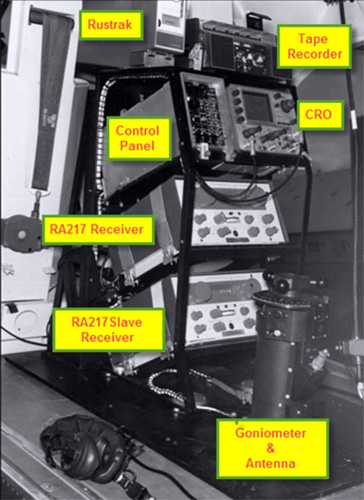
Photo courtesy of Pronto in Vietnam website
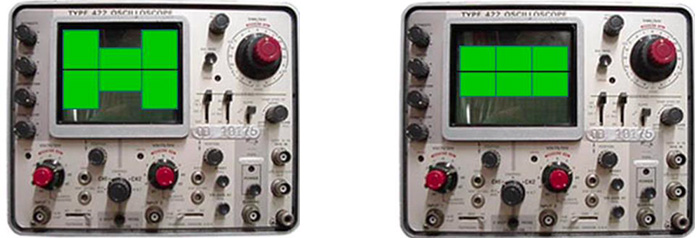
These two images show the screen of the 422 oscilloscope in operation.
Photos courtesy of Pronto in South Vietnam website
The left screen shows the 422 when a signal was acquired by the ARDF system. The right screen shows the 422 when the antenna was rotated to balance the signal legs indicating that the antenna was pointed directly at the transmitter to record the time and bearing.