
After Tektronix CRT Operation closed in 1996, Cathode Ray Technology B.V. in the Netherlands manufactured CRTs for the 1710J Series and WFM601 Series of Waveform Monitors until its closure in September 2012. Originally part of Philips, the CRT operation was named CRT-Heerlen in 1994. When that company went bankrupt in 2009, the employees managed a “start through” as Cathode Ray Technology. [External site] Glass funnels with flat, fritted faceplates formed the bulb of the CRT. The electron guns do not resemble the Tektronix style, with most metal parts being flat wafers rather than barrels. Also, the stem and base cap have smaller diameters than the standard Tektronix 14-pin base.
New Analog CRTs in TV Products after Tektronix CRT Plant Closure by Dan Baker
Television Products Waveform Division
When Tektronix ceased internal CRT manufacturing, the TV Products Waveform Division (TVWD) maintained several high-margin core products. These were based on a custom Post-Deflection Acceleration (PDA) mesh CRT, specifically optimized for waveform monitors. This CRT featured a high-brightness display critical for the TV line-select function, enabling a single line out of 625 to remain visible even under 10x vertical and 25x horizontal magnification.
Each application utilized a parallax-free internal graticule. While the vertical bandwidth required was only approximately 60 MHz, a standard Gaussian response typical of oscilloscopes was insufficient; the response had to be flat within 1% up to 20 MHz and for HDTV, 30MHz. Since video signals were typically band-limited, the flat response did not cause any overshoot. The Tektronix design proved highly effective and cost-efficient, contributing significantly to product margins.
Key products utilizing this CRT included the 1710, 1720, and 1730 series. Later, the WFM300 component waveform monitor and the 1730D, designed for emerging serial digital video, were introduced. The 1730D also incorporated an equivalent-time eye-pattern display.
The Evolution of Graticules and Phosphor Preferences
The WFM300 required a dynamic readout and an electronic graticule, utilizing the multiplexed-beam stroke writing exclusive to television. Initially, Marketing insisted that the electronic graticule be a different color from the waveform and vector displays. Consequently, a bright display was developed using P4 white phosphor and a low-transmission, blue, color-shutter filter ($100 option) to create a blue graticule over white waveforms. However, customers soon found the electronic graticule highly functional without the color distinction, and the option was ultimately discontinued.
Following this, customers across the 1700 series began requesting white phosphor to better align with the D65 (6500 K) illuminant color standard. Video colorists, becoming increasingly central to production, found that the traditional green phosphor biased their perception of the white reference on the picture monitors. In some environments, even green panel LEDs had to be muted or disabled to not distract the colorist.
Transition to Philips Heerlen
To address these needs, Robin Burnham’s team and I traveled to Europe to secure a new vendor. The Philips plant in Heerlen, Netherlands, possessed the necessary tooling and was willing to adapt its glass funnel CRT process to our requirements. Their CRTs featured a robust long-life dispenser cathode derived from Philips professional imaging tubes. I collaborated with the Heerlen team to modify the CRT design and oversaw the electrical and mechanical changes required for integration across the 1700 and WFM series.
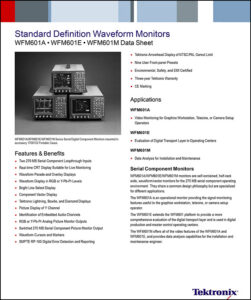
TVWD subsequently introduced the WFM601A, WFM601E, and WFM601M, which featured a 1.5 GHz eye-pattern display along with full waveform and vector capabilities. The WFM601 series processed a 270 Mb/s serial digital input, reconstructing an ideal interpolated analog signal for the CRT using a custom ASIC from Grass Valley Group. These products were highly successful; the Heerlen CRT was not only performant but also more cost-effective than the original Tektronix CRT. Notably, Philips Heerlen supplied a D65 white reference phosphor, a feature that competitors lacked.
The Shift to Raster Displays
Concurrently, TVWD explored various raster waveform methods suitable for video professionals. Creating usable video waveforms on a raster display is challenging, as directed-beam CRTs provide significantly higher contrast ratios, revealing low-duty-cycle characteristics in waveforms and vectors. While customers were initially skeptical that raster-based LCD panels could match CRT quality, the eventual development of high-dynamic-range waveform raster reconstruction proved acceptable, though still not quite as good overall as the directed-beam CRT. This led to the replacement of analog CRT-based products with LCD flat-panel displays in the WFM7000 series, introduced in 2006.”
Tektronix first CRT product, the 511 oscilloscope, began with a purchased CRT. After a 40+ year successful internal CRT operation, Tektronix last analog CRT product, the WFM601 Series, also ended with a purchased CRT. Click on the image to view the WFM601 datasheet PDF.
These CRTs are on exhibit at the museum in our CRT display case.
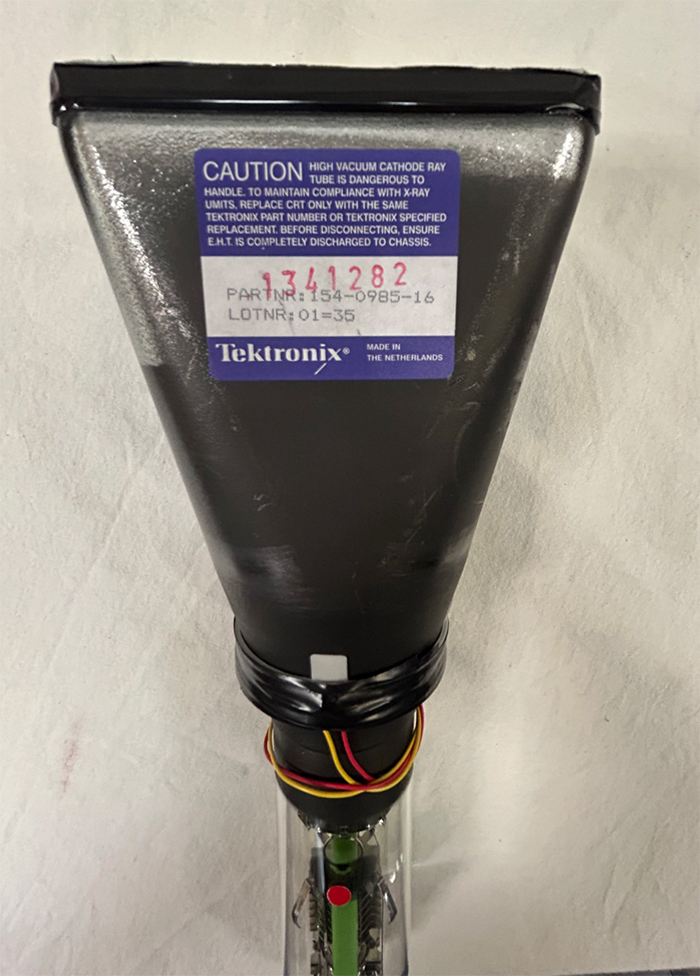
154-0985-16. Week 35, 2001 Date Code
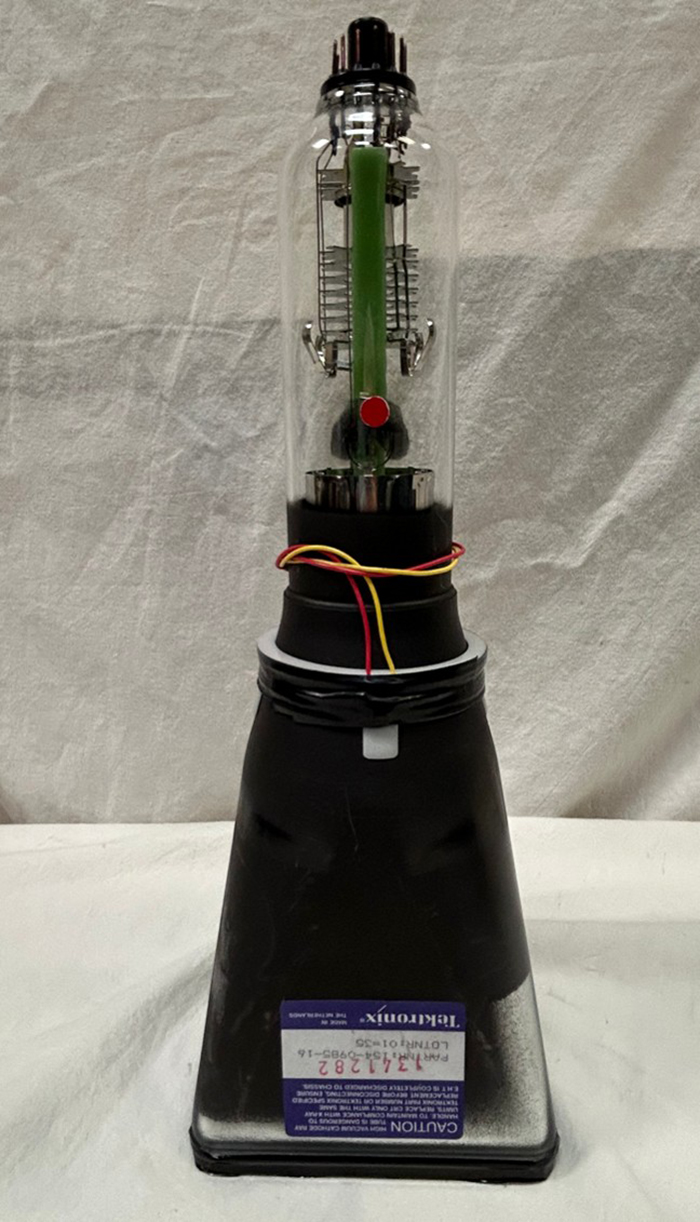
Glass bulb fritted to flat faceplate
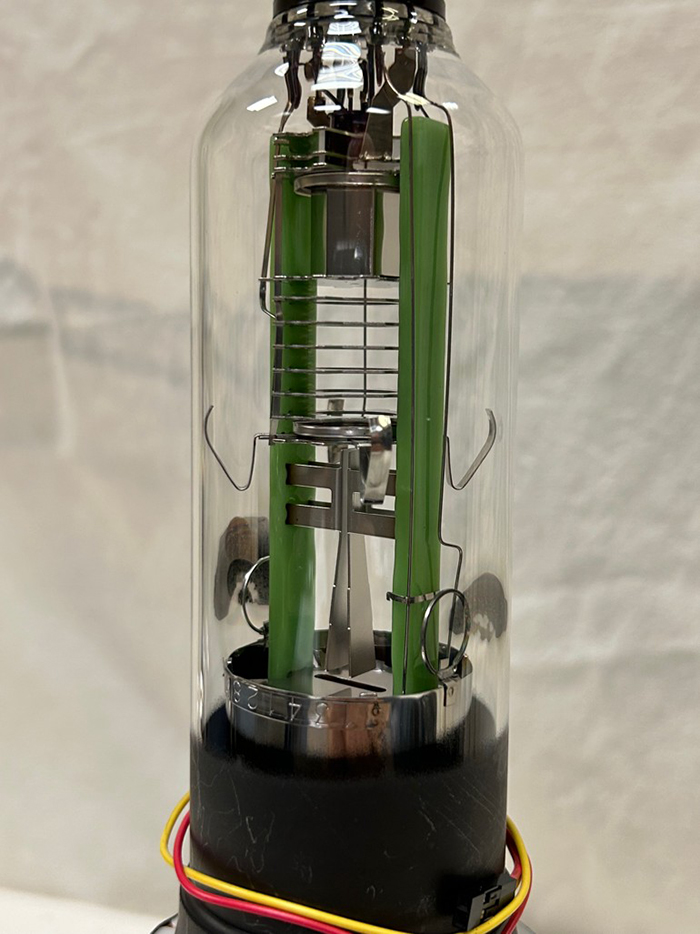
Domed Mesh Scan Expansion Design, +13.5kV Overall
1710J Series CRT Options
154–0985–00 ELECTRON TUBE: CRT, FINISHED, D14–375GH/985 (1710J ONLY)
154–0985–16 ELECTRON,TUBE: CRT, FINISHED, D14–375WA/985 (1710J OPTION 74 ONLY)
154–0986–00 ELECTRON TUBE: CRT, FINISHED, D14–375GH/986 (1711J ONLY)
154–0986–16 ELECTRON,TUBE: CRT, FINISHED, D14–375WA/986 (1711J OPTION 74 ONLY)
WFM601A, WFM601E, WFM601M CRT
154-0988-16, D14-375 WA/988
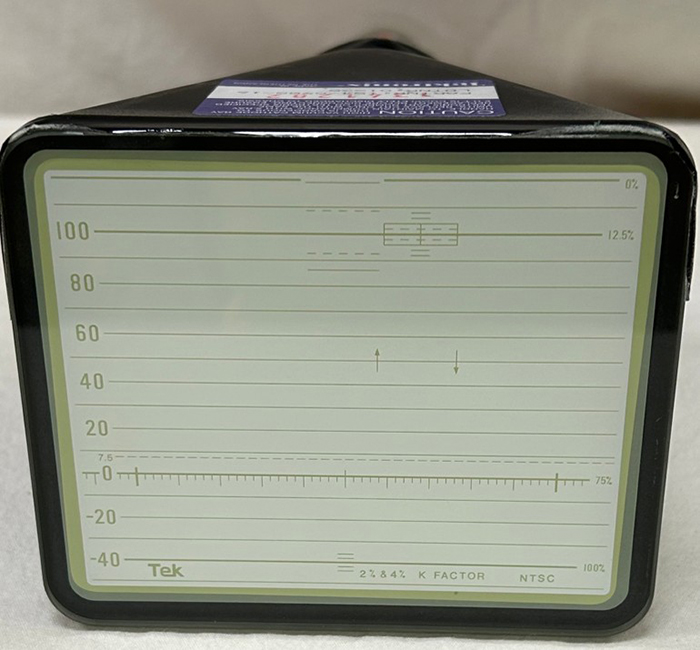
1710J Family NTSC Vectorscope graticule
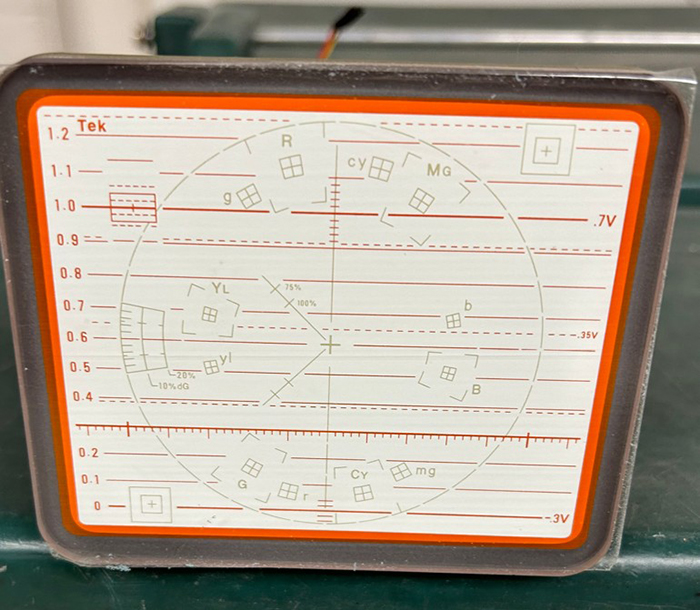
154-0993-00 CRT graticule
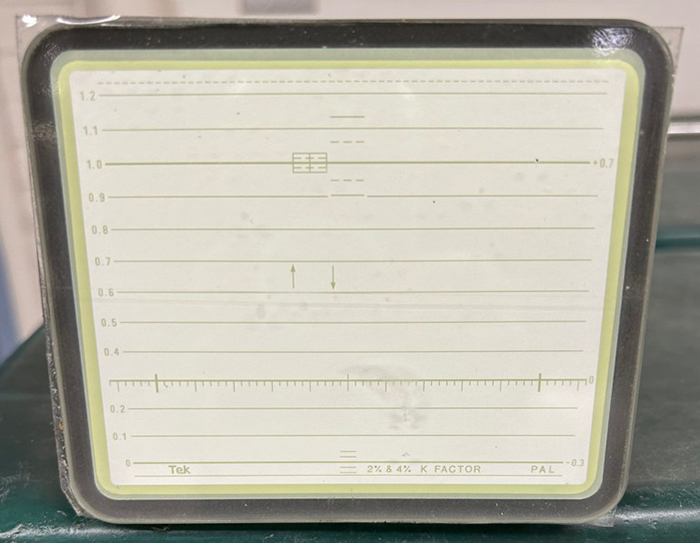
154-0986-16 CRT graticule
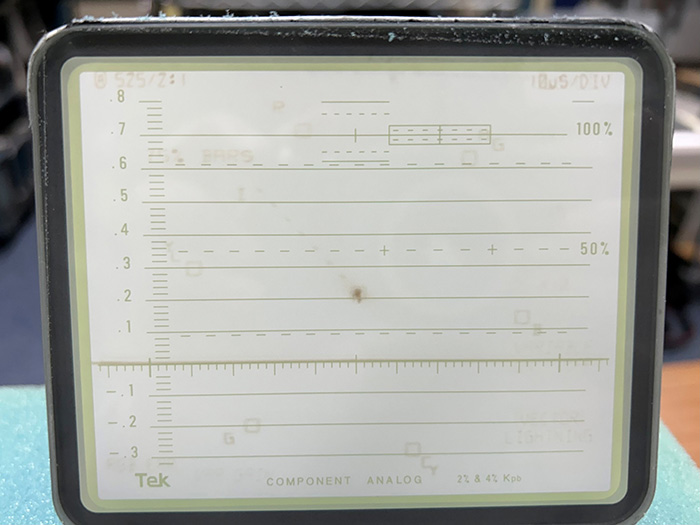
Used 154-0988-16 CRT - notice the residual characters and patterns on the graticule as a result of tens of thousands of hours of use